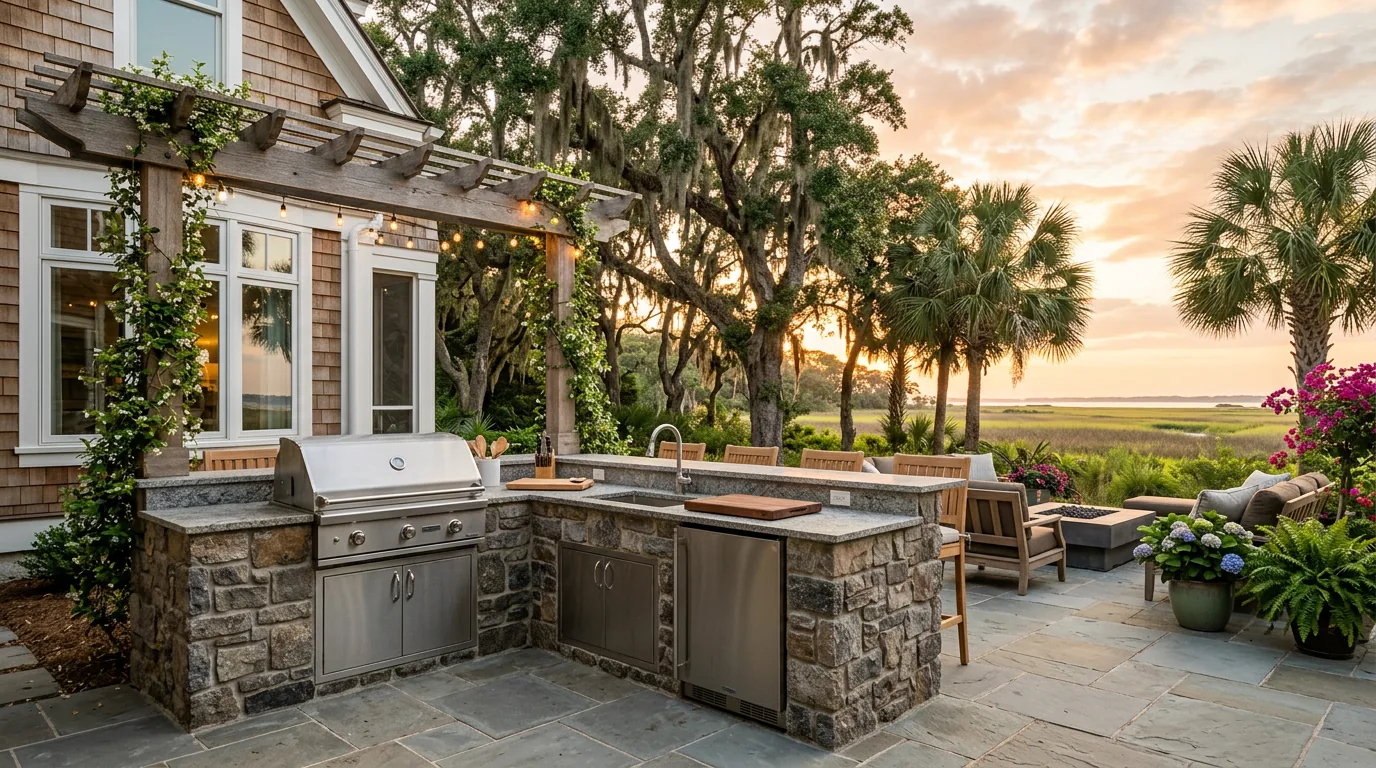
Kiawah Island outdoor kitchen
Salt-air exposure required 316 stainless hardware, a full masonry shell, and ventilation detailed for a coastal lot. Same specification class as Sullivan's Island — barrier-island kitchen planning.
DCM Outdoor is the outdoor kitchen builder Charleston homeowners hire for a full design-build kitchen — and the backyard kitchen builders Charleston SC teams call when masonry, 316 stainless, gas, power, and water have to land as one scope, not a grill island plus a later contractor.
Real kitchens built for coastal entertaining — not catalog renders. Barrier-island planning: Sullivan's Island, Isle of Palms, Kiawah Island.

Browse more installed projects → · Lifestyle outdoor kitchen ideas →
Two recent kitchen scopes that show how framing, stainless grade, and site exposure change the specification.
Salt-air exposure required 316 stainless hardware, a full masonry shell, and ventilation detailed for a coastal lot. Same specification class as Sullivan's Island — barrier-island kitchen planning.
An L-shaped cooking and bar layout added prep and refrigeration without crowding the yard — masonry base, outdoor grill package, and patio slope integrated so rinse-down water moves away from the structure.
Kitchen-only showrooms win on appliance SKUs. DCM Outdoor wins when the job needs a masonry shell, permit path, licensed gas and electrical trades, and patio or shade planned together — the full scope Charleston and barrier-island homeowners actually hire for.
Mount Pleasant, Sullivan's Island, Isle of Palms, and Kiawah each document local review and coastal spec — start on the town page that matches your lot.
Photographed installs and written scopes on Mount Pleasant and Kiawah Island — compare before a showroom visit.
Prefab vs custom, wood vs masonry, and 304 vs 316 stainless explain why coastal shells differ from catalog islands.
Portable grills rust and roll. Big-box cabinet kits use fasteners and panels that swell and delaminate when humidity never drops. Indoor-rated finishes chalk and fail outside. A DCM Outdoor kitchen is masonry-built, appliance-specific, and ventilated for real Charleston use — not a catalog photo adapted to our zip code.
Coastal and near-coastal properties expose stainless, stone, and sealants to chloride-laden air. Inland appliance packages and hardware schedules fail here first. We baseline materials and fasteners for the actual microclimate of your lot — not a generic “outdoor rated” label.
Gas line sizing, electrical load centers, GFCI placement, and water/drain routing have to agree before masonry closes them in. DCM Outdoor locks the appliance schedule and rough-in plan early so you are not paying to cut finished veneer because a burner line conflicted with a drawer stack.
The prevailing afternoon breeze in Charleston is not an afterthought. We place cooktops, hoods, and seating so smoke clears the dining zone and guests are not standing in the exhaust plume. That decision belongs in layout — not after the stone is set.
Porous outdoor concrete tops stain under live oak canopy and party use. Porcelain slab gives near-zero absorption, UV stability, and cleanable joints — the reason we specify it as the default finish for serious cooking stations in the Lowcountry.
An outdoor kitchen isolated from the paver field, pergola columns, and lighting plan always looks like an add-on. DCM Outdoor aligns counter height, step transitions, column bases, and conduit paths with the rest of your outdoor living investment.
Buyers in Mount Pleasant, Daniel Island, and the islands respond to finished masonry kitchens with nameplate appliances and clean permits — not a temporary cooking corner. Quality outdoor kitchens remain one of the strongest lifestyle signals in Charleston’s competitive resale tiers.
Wood-framed outdoor kitchens rot from the inside out in Lowcountry humidity; you cannot see the damage until doors stop closing. DCM Outdoor builds from concrete masonry / engineered steel or welded aluminum framing — then applies stone veneer or exterior-rated cladding designed for splash zones against the brick, fiber-cement, and vinyl exteriors common across Charleston.
Masonry (CMU or steel + cement board) is our default for heavy stone veneer, tall bars, and kitchens that must read as architecture attached to the home. Welded aluminum is a strong option when you want a lighter, corrosion-resistant shell with faster install and clean appliance cutouts — finished in stucco, veneer, or panel systems. We help you choose based on veneer weight, coastal exposure, HOA appearance rules, and budget — not a one-frame catalog.
Structural walls carry countertop dead load, appliance cutouts, and cantilevered bars without flexing the veneer. Every opening is sleeved for gas and electrical penetrations. Best when the kitchen should feel permanent and stone-heavy.
Solid-welded aluminum resists rust and stays square under humidity swings. Ideal for many grill islands and mid-weight finishes when weight, speed, or coastal corrosion resistance drives the decision. Finishes and appliance openings are still planned before cladding closes.
Heat resistance near grills, near-zero absorption against spills and pollen, and UV-stable color. Natural stone is available where the design calls for it — with a sealing schedule you can keep.
304 stainless is common on inland outdoor packages and can perform well away from salt air — but it pits faster when chloride exposure is high. 316 stainless (molybdenum-bearing) is our baseline for door/drawer hardware, fasteners, and appliance packages within roughly five miles of the coast, on barrier islands, and beside pools with splash and salt. Specifying the wrong grade is one of the fastest ways a “new” kitchen looks tired in Charleston.
Design detail that matters: DCM Outdoor maps grill venting, combustible clearances, ceiling fans, and pendant locations against prevailing wind so smoke clears the seating zone and heat stays away from wood soffits, vinyl siding, and covered structures — decisions that belong in layout, not after stone is set.
The appliance schedule drives gas BTU load, electrical circuits, drain routing, and cutout dimensions. We lock that list before framing closes so you are not cutting finished veneer to fix a missed drawer bank or ice maker circuit.
Built-in grills, side burners, griddles, and specialty cooktops sized to how you host — with ventilation and clearance documented for open-air or covered outdoor rooms.
Under-counter refrigeration, beverage centers, and ice makers on dedicated circuits with GFCI protection where required — planned with spare capacity for seasonal loads.
Hot/cold prep sinks with proper venting and backflow protection so rinse-down and cleanup stay on the patio instead of tracking through the house.
Storage banks, trash pull-outs, and paper-towel niches placed where the cook actually reaches — with coastal-grade hardware on salt-air lots.
The right layout depends on how you cook, how guests circulate, and how the kitchen relates to pool decks, lawn, and interior doors. These are not catalogs — they are starting points we adapt to your survey, utilities, and HOA sight-line rules.
Grill and refrigeration on one leg, bar seating on the other — guests face the cook without standing in the work triangle. Pairs naturally with a perpendicular dining or fire area on the paver field.
Single elevation following the rear façade — fastest utility paths, minimal footprint, ideal when setbacks or easements limit depth. We watch roof drip lines and soffit heights so finishes and vent terminations stay code-compliant.
360° access for buffet service and bartending — ideal when the kitchen anchors a larger patio. Requires early planning for conduit, footings, and wind exposure on open sides.
Ceiling fans, heaters, and lighting integrate with the structure instead of fighting it. We coordinate beam loads, hood terminations, and finished ceiling heights with your shade contractor — or we build the full structure in-house when bundled.
Most outdoor kitchen change orders trace to utilities that were guessed instead of calculated: undersized gas lines to combined grills and side burners, GFCI routes that do not reach ice makers, or sink drains that cannot find daylight. DCM Outdoor sizes loads off the appliance list and routes every sleeve before veneer.
We total burner, griddle, and fryer demand, then specify pipe sizing and regulator placement so you are not starving the grill on a Friday night. Future appliance swaps are easier when the line was built for realistic peaks — not today’s minimum.
Dedicated circuits for cooling loads, GFCI protection where required, and spare capacity for seasonal lighting or heaters. Conduit paths are coordinated with your landscape lighting zones when DCM Outdoor is doing both scopes.
Hot/cold sinks get proper venting and backflow protection for outdoor hose bibs and rinse stations. We align trenching with irrigation and drainage so you are not tearing up new pavers to fix a missed sleeve.
Open-air kitchens may still need capture for smoke under solid covers. We document hood height, projection, makeup air, and manufacturer clearances to combustible materials (soffits, pergola beams, vinyl, wood trim) so heat and grease stay code-safe — not guessed after install.
Kitchen pads need a stable base, correct slope, and drainage so rinse-down and stormwater do not pond at appliance feet or toward the house. When we also install your paver field, sleeves for gas, electric, and drain can run under the structural slab before it is poured. If another contractor already poured concrete, we map core-drill paths that protect steel and post-tension elements — but earlier coordination always costs less. See also paver patio construction in Charleston.
Outdoor kitchens routinely need gas and electrical permits; many scopes also trigger building permits when structures, roofs, or load-bearing counters exceed jurisdictional thresholds. In communities like Daniel Island, Kiawah, or Dunes West, architectural review boards often control materials, sight lines, and impervious coverage — we prepare submission sets that match those requirements the first time.
DCM Outdoor files and tracks permits as part of standard project management. You are not chasing inspectors between subcontractors. Typical construction duration after approval runs three to six weeks depending on appliance lead times, veneer complexity, and weather windows for masonry curing — with a written completion date in your agreement.
Every kitchen is quoted after a site visit and appliance schedule lock. Ranges below reflect common installed scopes we see across the metro area; premium appliances, stone selections, long gas runs, or structural roofs move the needle quickly — which is why we itemize allowances instead of hiding them.
The expensive mistakes in outdoor kitchens happen while everything is still open: wrong sleeve placement, inadequate gas volume, or a drain that missed the slab. Our sequence keeps inspections and load tests ahead of finishes.
We map gas meter capacity, electrical panel capacity, water sources, drainage options, and HOA rules. Appliance wish lists turn into real load calculations — not placeholders.
Layouts, elevations, and sleeve locations are documented for masonry, MEP, and paver scopes. You see where every line enters and exits before we build.
DCM Outdoor files gas, electrical, and building permits as required and manages resubmittals. HOA packages include finishes, dimensions, and sections reviewers expect.
Footings and slabs tie to your paver or deck system for clean transitions. Sleeves and boxes are set before pours when possible.
Block or steel framing, cement board, and sleeved penetrations. Gas and electrical roughs are inspected before close-in.
Stone veneer and exterior cladding, porcelain tops, and appliance fitment with factory tolerances protected.
Burner tuning, leak checks, GFCI verification, and lighting aim. You get conduit maps and maintenance notes before we close the job.
The same masonry standards and scheduling discipline apply whether we are on a custom home, a production lot, or a managed estate — only the documentation volume changes.
Buyers decide quickly when the outdoor kitchen reads as complete — not a future allowance. DCM Outdoor sequences kitchen, patio, and shade packages to your closing milestones with finishes that photograph well at model previews.
We deliver sleeve locations, loads, and inspection schedules so your MEP trades are not reworked after masonry starts. One point of contact for veneer, countertops, and appliance fit reduces punch-list churn.
Rental-adjacent pools and clubhouses need hardware and surfaces that tolerate constant moisture and cleaning. We specify accordingly — and document warranty paths for commercial-grade components when the scope requires them.
Tell us how you cook, how you entertain, and what you want tied into the same project as your patio or shade structure. We will translate it into a buildable plan with permits handled.
Most projects fall between roughly $18k for a compact masonry cooking wall and six figures for large islands with premium refrigeration and multiple fuels. Appliance packages and structural roofs move the range more than stone color. DCM Outdoor provides line-item estimates once appliances and utilities are defined — not a bait-and-switch allowance.
Gas and electrical work typically require permits; structural roofs, concrete pads beyond thresholds, or retaining features may add building permits. DCM Outdoor identifies jurisdiction-specific requirements during design and files on your behalf.
Yes. Many Lowcountry lots carry flood designations. We align finished floor elevations, equipment anchorage, and utility entries with your survey and local amendments so the kitchen complies alongside your deck or pool work.
After permits, most kitchens finish in three to six weeks depending on masonry curing, stone lead times, and appliance deliveries. We give a written completion date tied to those inputs — not a generic “4 weeks” guess.
Porcelain tops need wiping; stainless needs occasional polishing; stone veneers benefit from periodic rinsing to remove pollen and oak debris. We walk you through simple seasonal care — no mystery sealers unless your stone selection requires them.
See our Outdoor Kitchen Guide for Charleston for planning timelines, appliance priorities, and coordination tips.
Most kitchens sit on a paver patio and tie into shade, fire, and lighting. If we are already on site, those scopes stay visually and structurally consistent.
Walk the property with us — we will translate how you cook into a buildable plan with framing choice, stainless grade, utility loads, permits, and a written completion date.
Schedule a Kitchen Consultation →843-270-2043 · hello@charlestonoutdoorliving.com
Charleston outdoor living services