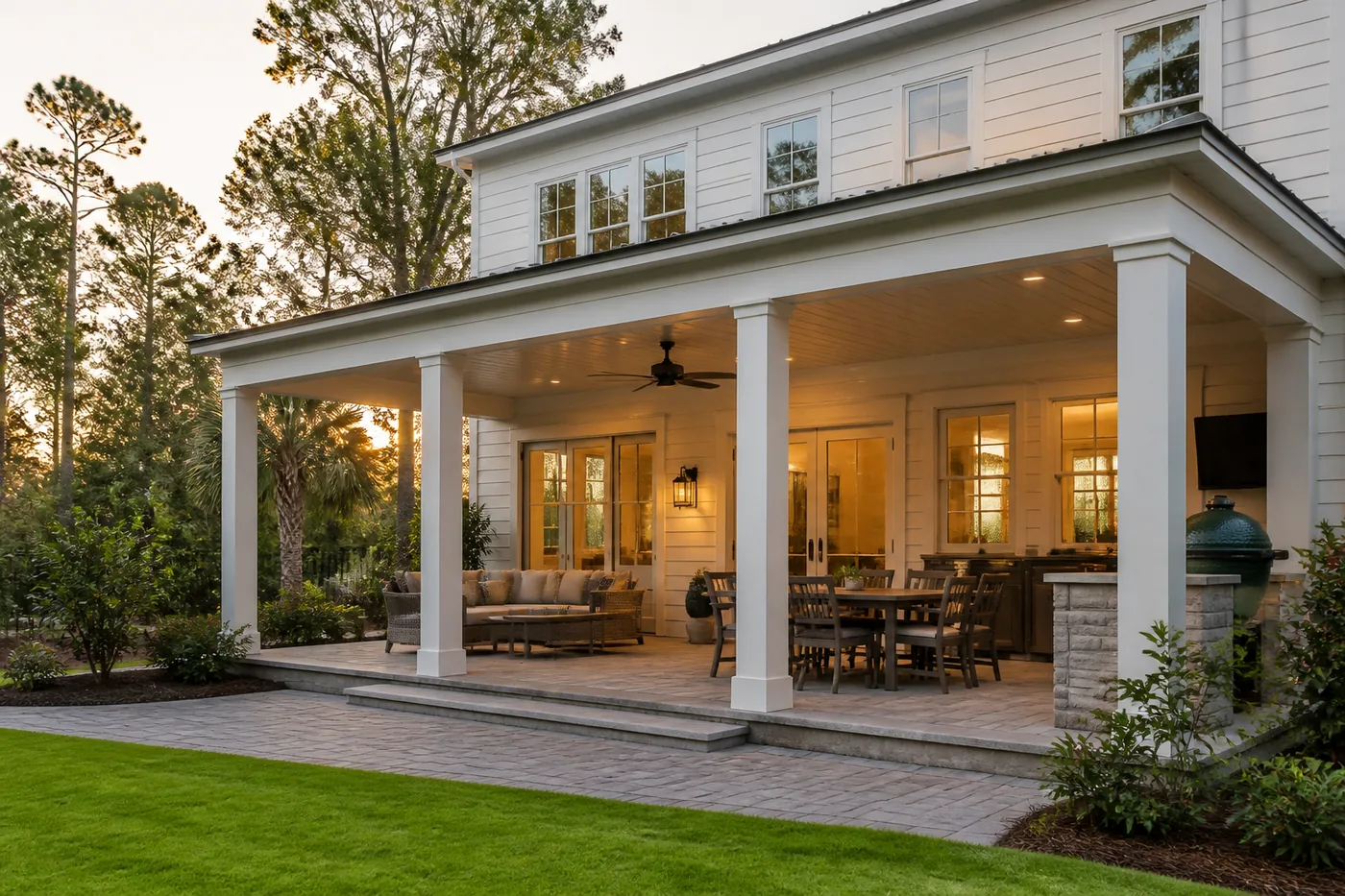
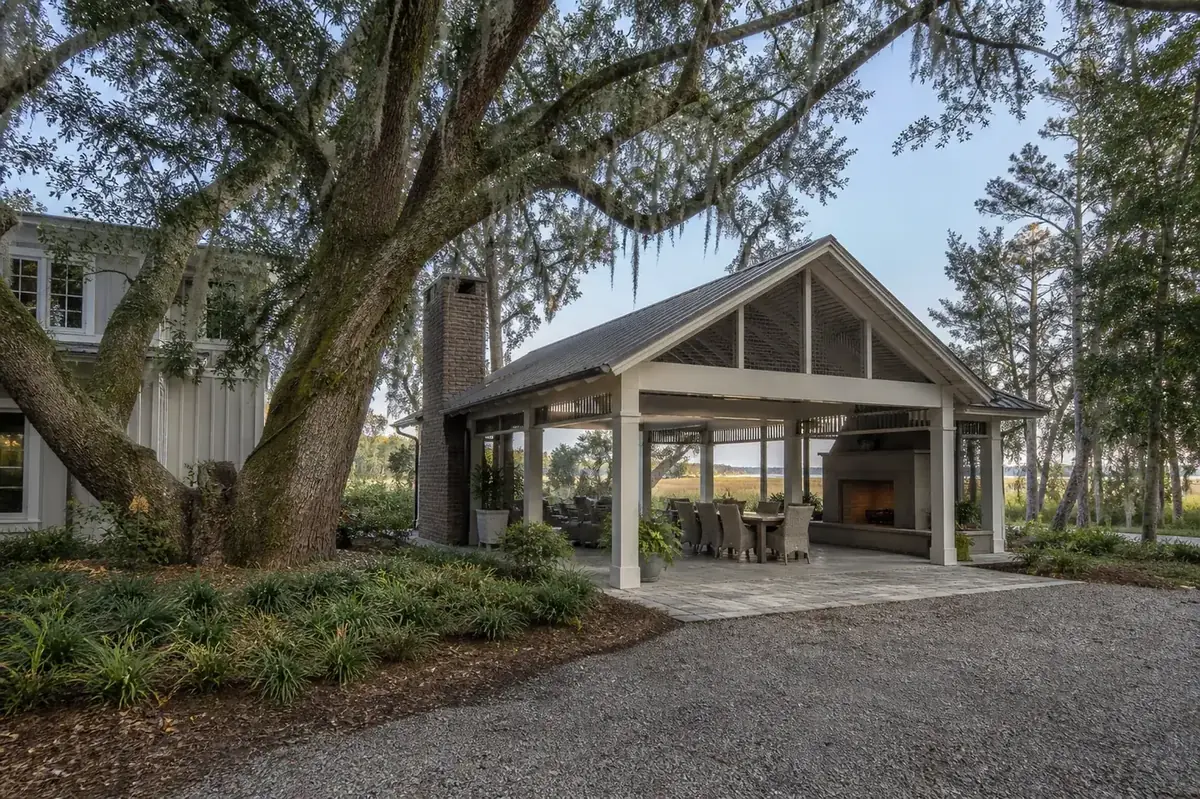
Pergolas, Patio Covers & Outdoor Living Pavilions in Charleston, SC
DCM Outdoor is the pergola and pavilion builder Charleston homeowners hire for open pergolas, motorized louvered roofs, and solid-roof outdoor living pavilions — coordinated with your patio, outdoor kitchen, lighting, and drainage so shade performs as part of the outdoor room, not a bolt-on afterthought.
Open pergolas from $14k–$28k · Louvered roofs $32k–$75k · Solid pavilions $45k–$110k+ · Full cost guide →
✓ Engineered for Charleston’s coastal wind conditions✓ Permit & HOA requirements verified by property✓ Patio & kitchen integration✓ Clear schedule after site review
Shade That Belongs to the Whole Backyard — Not Just the Structure
Specialty pergola companies focus on the cover itself. DCM Outdoor designs and coordinates the complete environment beneath and around it — patio, drainage, outdoor kitchen, lighting, fire features, and landscaping — so the shade structure, hardscape, and utilities read as one outdoor room.
That is the advantage on larger Charleston projects: one consultation, one design path, and one crew schedule for the structure and what it sits on. If you only need a standalone pergola, we still build it correctly for coastal conditions. If you are planning a full backyard, we keep the column layout, drainage, kitchen clearances, and lighting on the same plan.
Project photography
Charleston Pergola & Patio Cover Gallery
Finished shade structures, beam detailing, framing progress, and outdoor-room integration. We are expanding this gallery with footing and anchorage photos, post bases before concealment, gutter details, fan and lighting rough-ins, and patio transitions as each new project is documented.
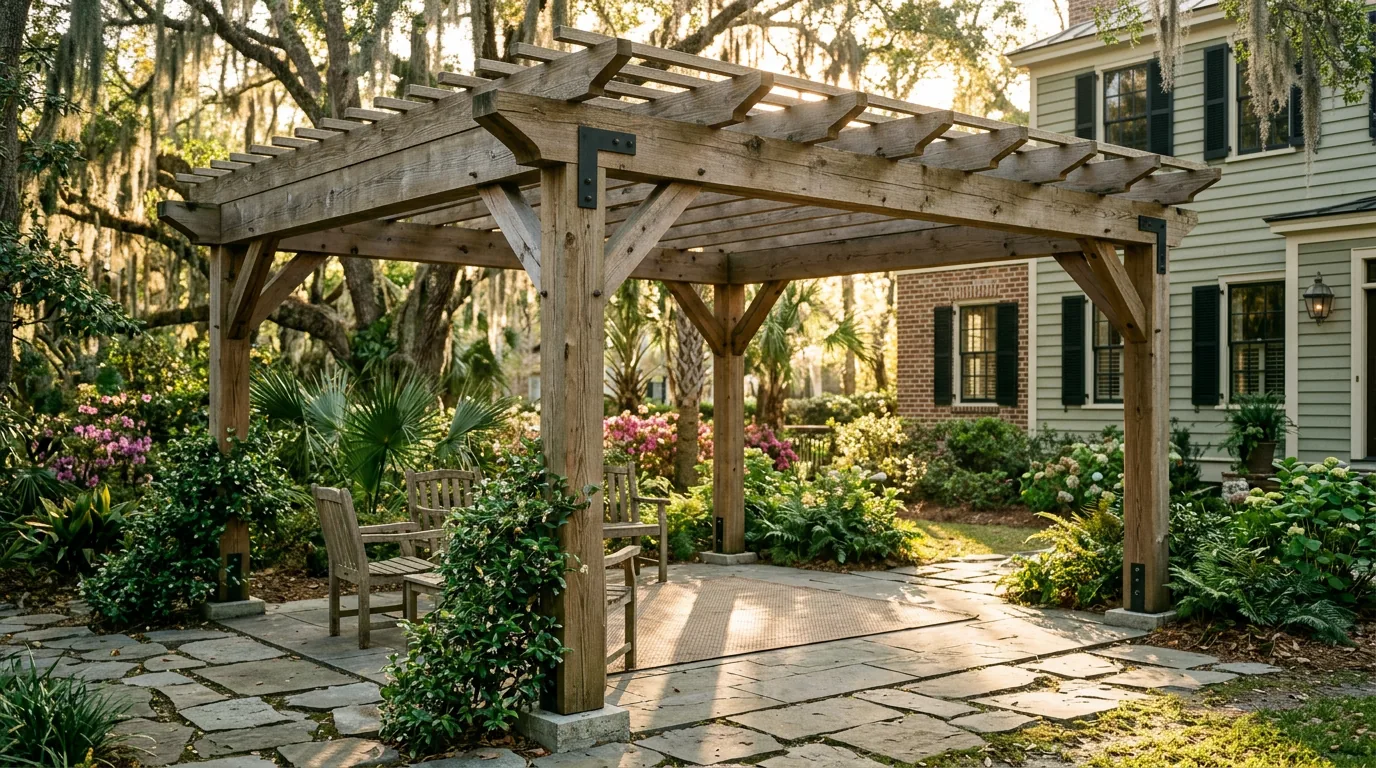
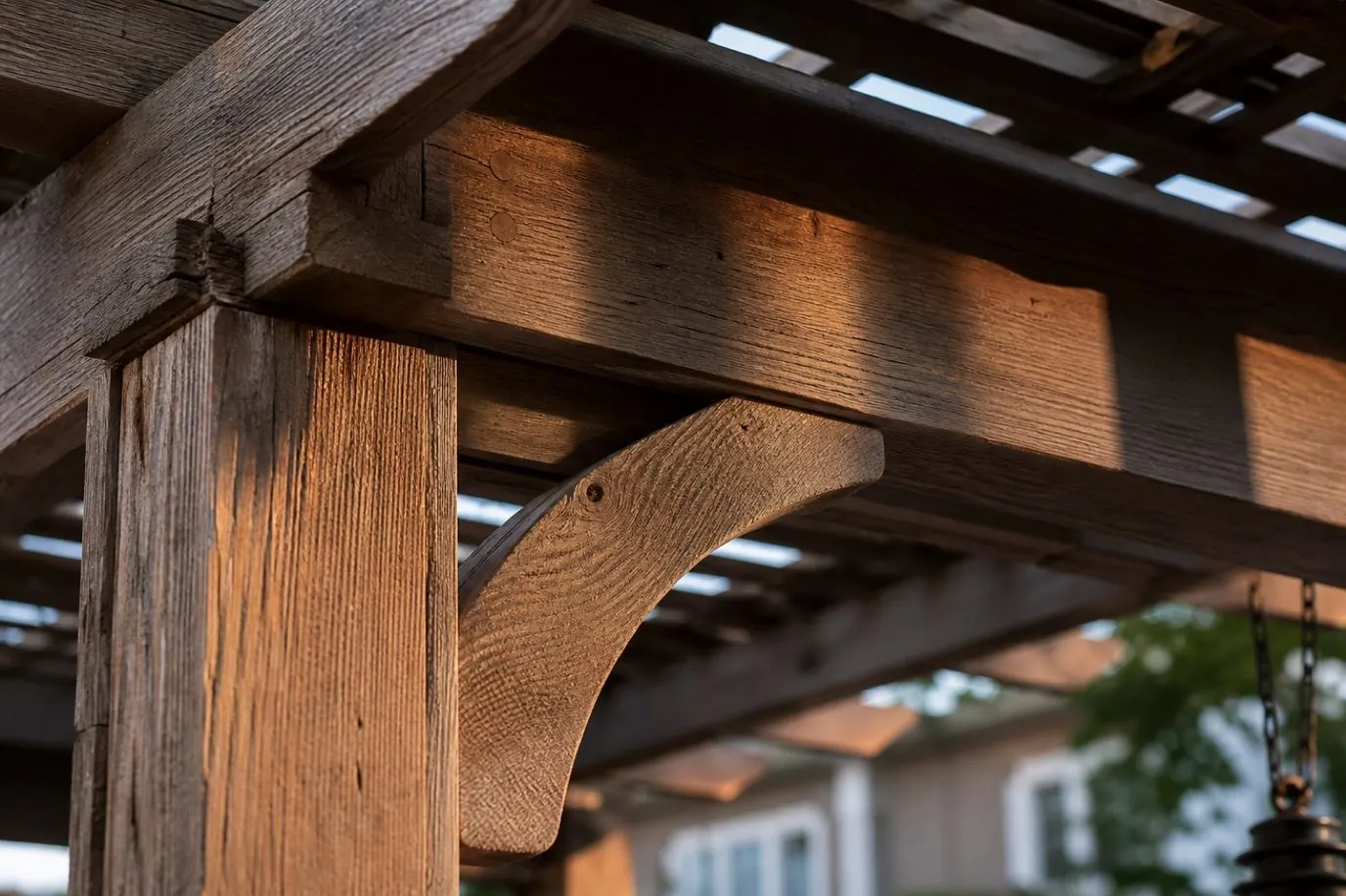
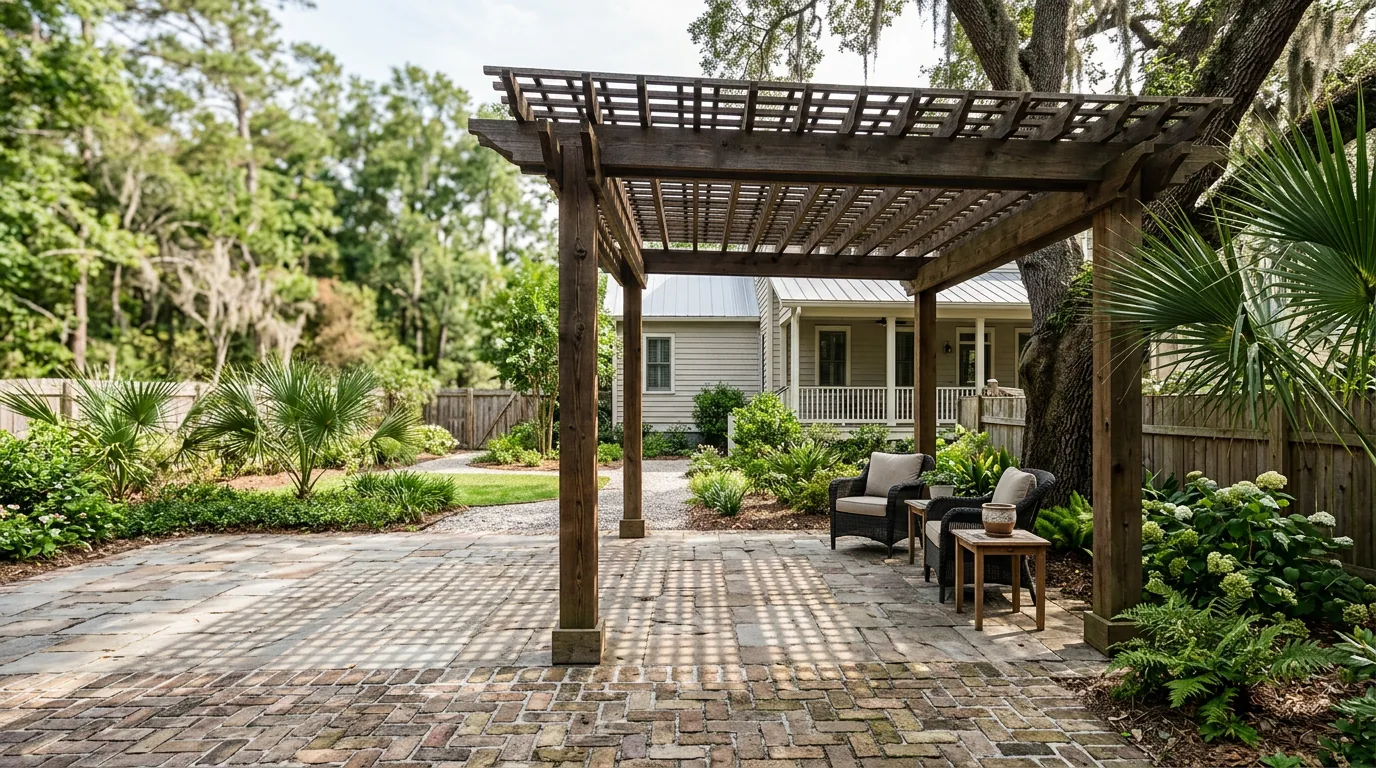
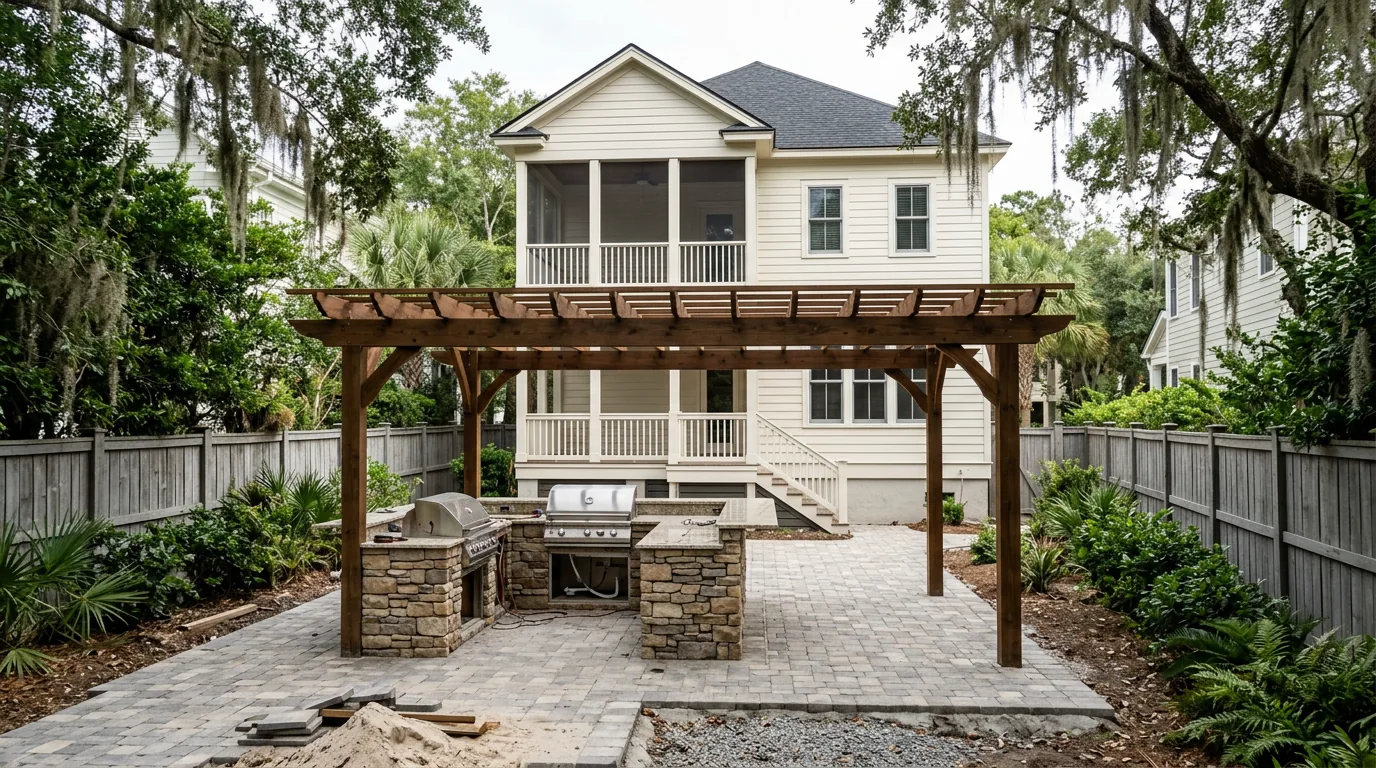
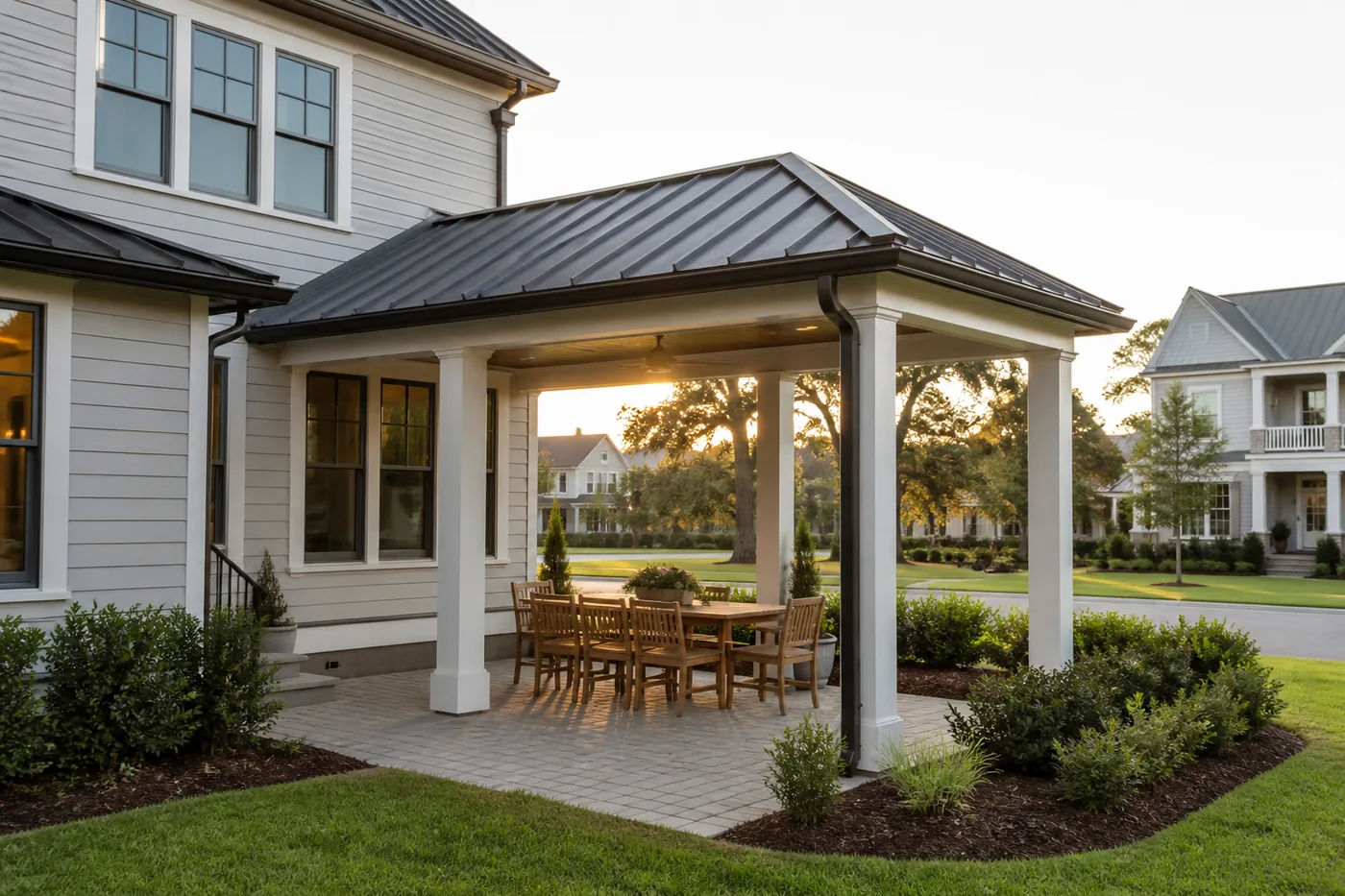
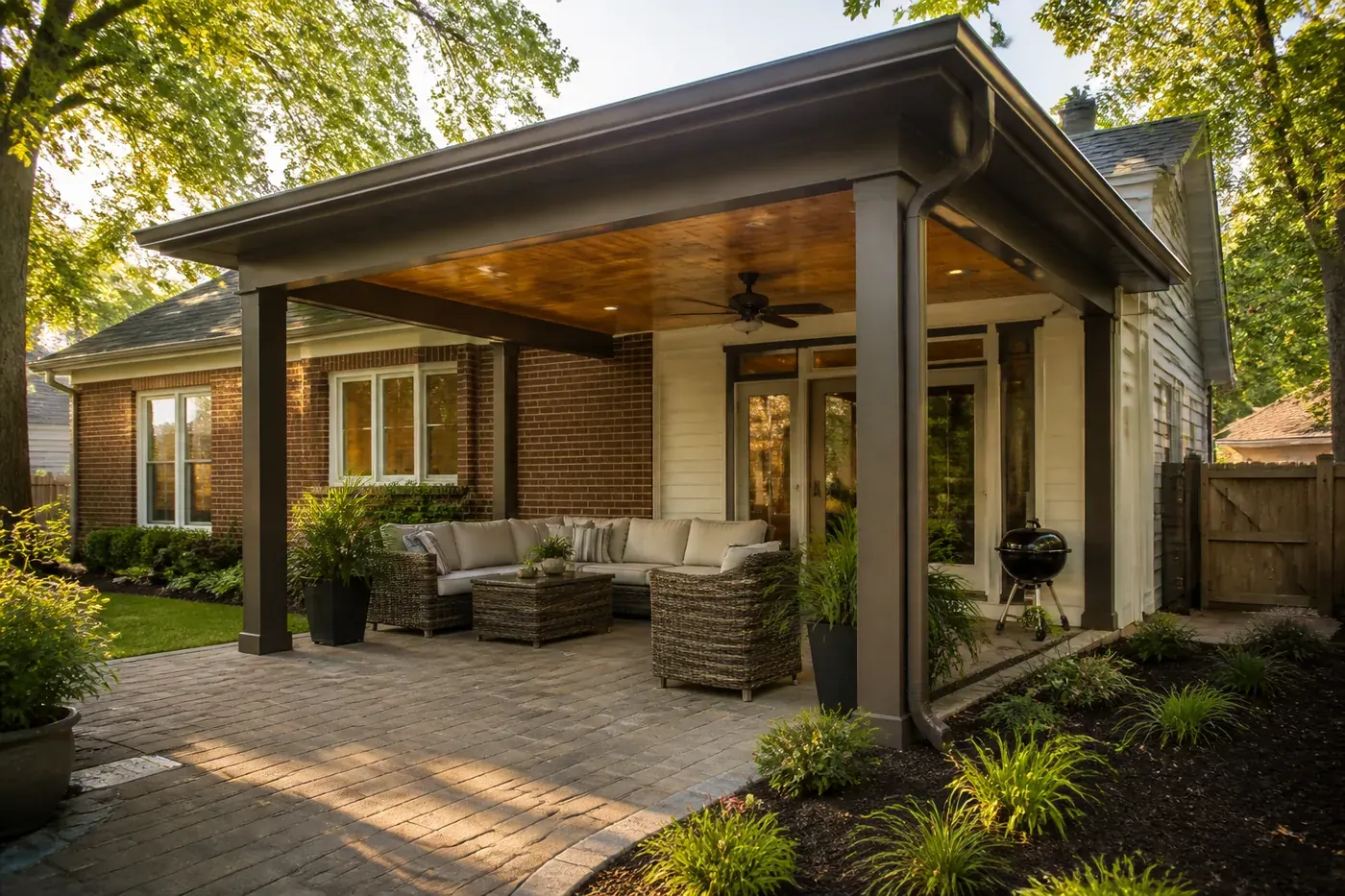
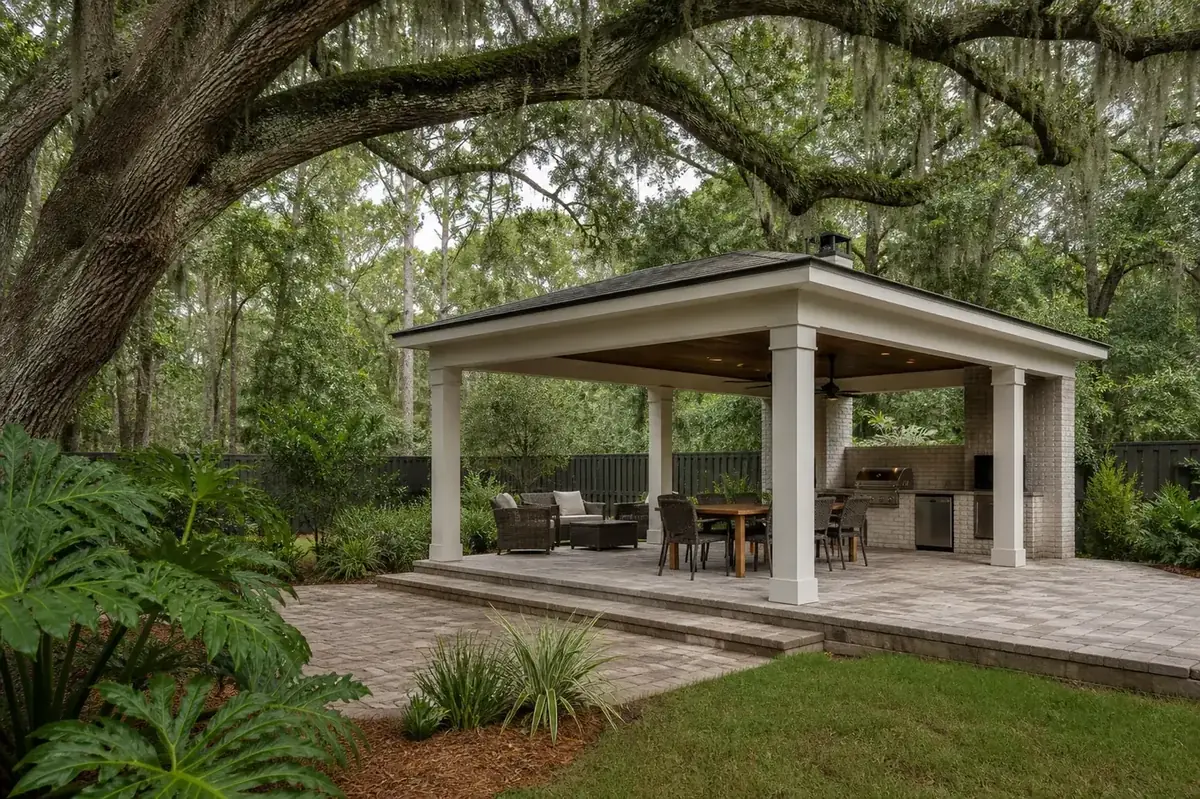
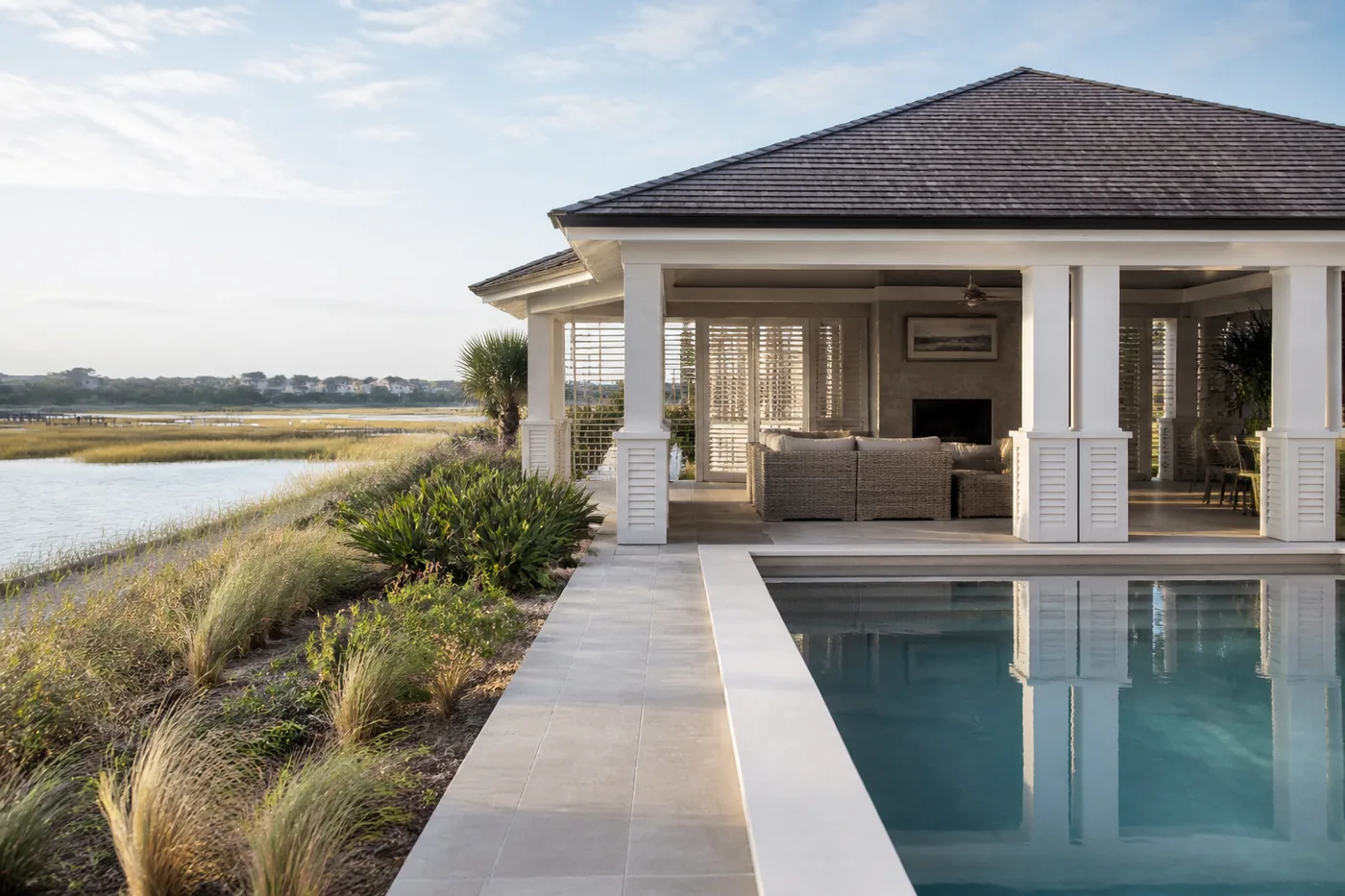
Open pergola shade coordinated with patio seating.Beam and connection detailing before finish trim.Patio cover as part of a complete outdoor living layout.Structure set during an integrated backyard build.
Shade and outdoor living decisions are easier when you know who is accountable for the plan.
Donovan McDaniel
Owner and Project Lead, DCM Outdoor
Donovan leads homeowner consultations, design decisions, and construction oversight for Charleston outdoor living projects — including pergolas, patio covers, and the patio, kitchen, lighting, and drainage scopes that make shade usable year-round. You meet the person who owns the schedule and the finished result, not a revolving sales handoff.
Each format solves a different use case. Many properties combine an open dining pergola with a smaller louvered section over a lounge or outdoor kitchen where rain closure matters most. Compare options in our open vs louvered guide and pergola vs covered patio comparison.
Filtered shade
Open pergola — timber or aluminum
Lattice or open rafters give dappled shade and maximum breeze — ideal for dining zones, climbing vines, and lighter visual weight against historic façades.
✓ Fan and speaker blocking planned in the beam layout
✓ Lighting conduit coordinated before finish
Most versatile
Motorized louvered roof
Adjustable blades close for cover in minutes, then reopen for airflow and star viewing — practical for Lowcountry storms over kitchens and deep seating. See louvered roof pricing.
✓ Integrated gutter and leader routing to grade
✓ Optional screens, heaters, and fan pockets
✓ Manufacturer storm settings documented at handover
Full outdoor room
Solid-roof pavilion
Fixed roof panels create a true outdoor living pavilion for all-weather dining, TVs, or poolside seating. We engineer slope, drip lines, and column loads so water sheds away from doors, windows, and pool coping.
✓ Ceiling fans and lighting per plan
✓ Column bases coordinated with hardscape
✓ Connections documented for permit review when required
Pergola builders
Pergola builders and installation in Charleston, SC
If you searched for custom pergola builders, pergola installation, or pergola construction in Charleston, this is the shade hub — open pergolas, louvered patio covers, and solid-roof outdoor living pavilions on one owner-led schedule.
Homeowners often use these words interchangeably. On this page they are three different shade types, and we specify the one that matches how you use the lot — after a site visit, not from a catalog name.
A pavilion is an open-air outdoor room with a solid roof: dining, seating, or a TV zone that still reads as part of the yard. An open pergola is lighter — rafters and breeze, not full weather cover. A cabana is typically more enclosed and sits at the pool: changing space, storage, or lounge walls with a roof. A pool pavilion is shade next to water, designed so columns, drip lines, and splash do not fight coping or the paver base.
A roofed outdoor-living structure is the broader category: any shade with a real roof plane rather than open rafters. That includes a custom outdoor pavilion, a louvered patio cover that closes, and some cabanas. If you searched for a pavilion contractor in Charleston, a backyard pavilion builder, or outdoor pavilion installation, this is the service hub — we still confirm the exact type on site instead of forcing one catalog name.
Published DCM shade work includes a West Ashley pergola with integrated lighting — an open pergola, not a cabana. We have not published a McClellanville, Awendaw, or enclosed-cabana case study on this site. If you searched for a cabana builder in West Ashley or a pool pavilion, start here and we will confirm the structure type on site.
Where we build shade
Outdoor living pavilions across Charleston neighborhoods
If you searched for an outdoor living pavilion near you, this is the metro page. We design backyard pavilions and patio covers for the lot in front of us — wind exposure, HOA, and drainage included — then build them as part of the outdoor room.
Barrier-island lots on Sullivan's Island and Isle of Palms need coastal-rated connections and salt-tolerant finishes — including a pool pavilion when shade sits next to water. Mount Pleasant and James Island backyard pavilions usually combine ARB packages with clay-soil footings. West Ashley and Daniel Island scopes often pair shade with an existing patio or kitchen. Northern Charleston County towns are covered below.
Daniel Island pavilions
Shade structures on Daniel Island are usually reviewed as part of the island's architectural package — column rhythm, roof profile, and finish samples need to read with the house and the street, not as a kit dropped on the patio.
DCM Outdoor designs backyard pavilions and patio covers for Daniel Island lots, coordinated with the patio and kitchen when those scopes are in the same plan. Start on the Daniel Island outdoor living page, then schedule an on-site consultation so we can walk setbacks, ARB drawings, and footing locations together.
Design illustration showing a solid-roof pavilion concept for a master-planned Daniel Island backyard.
Many West Ashley yards already have a patio or kitchen in place. The shade question is usually how to cover that existing floor without fighting drainage, mature trees, or a roof drip line that dumps onto the house.
We build open pergolas and solid-roof outdoor living pavilions in West Ashley as part of that outdoor room — including poolside pavilion scopes when shade sits next to coping and splash. See the West Ashley service area, then book a consultation on the lot before anyone orders a frame. Compare cabana versus solid-roof pavilion options on the same visit.
Design illustration showing a solid-roof pavilion concept for a West Ashley backyard with mature trees.
James Island lots often combine a high water table, heavy clay, and live-oak canopies. Pavilion footings and column layout have to respect those roots and how water already moves across the yard — not a copied downtown footing detail.
DCM Outdoor designs backyard pavilions for James Island outdoor rooms, including shade next to a rebuilt patio when drainage is part of the same job. Read the James Island page, then schedule a site visit so we can check soils, trees, and flood-zone status on the address.
Design illustration showing a solid-roof pavilion concept for a James Island backyard under live-oak canopy.
Barrier-island lots put shade next to salt air and, often, a pool or marsh breeze. Hardware, finishes, and how the roof sheds water matter more here than on a mainland street — especially if the structure sits near coping or a kitchen.
Mount Pleasant shade work often sits in HOA-governed neighborhoods where elevations, colors, and roof profile have to clear ARB review before construction. The structure still has to work with clay or fill soils and, on some streets, salt air from nearby tidal water.
DCM Outdoor designs outdoor living pavilions and pergolas in Mount Pleasant so the cover, patio, and kitchen can share one drawing set. Start on the Mount Pleasant page, then schedule a consultation to walk HOA rules and footing locations on your lot.
Design illustration showing a solid-roof pavilion concept for a Mount Pleasant HOA neighborhood backyard.
McClellanville sits in Charleston County, farther from the weekly metro hubs. Lots are typically more rural: longer material runs, more live-oak canopy, and accessory-structure rules that still go through county review rather than a downtown copy-paste spec. Availability depends on permits and crew routing for the address.
Outdoor living pavilions in McClellanville and Awendaw
McClellanville and Awendaw sit in Charleston County. DCM Outdoor designs outdoor living pavilions there when permits and crew routing line up for the address — the same owner-led shade process as the rest of the metro, not a separate thin town page.
Those lots are typically more rural than Mount Pleasant or West Ashley: longer drives for materials, more live-oak canopy, and accessory-structure rules that still run through Charleston County zoning / code enforcement. We verify setbacks, size thresholds, and whether a building permit is required for that structure — the same county guidance already cited on this page — then confirm wind exposure and footings for the lot, not a downtown copy-paste spec.
We have not published a McClellanville or Awendaw pavilion case study with photography on this site. Until a documented project is on our work, treat northern-county availability as confirmed per address. Service areas lists the weekly metro hubs; request an estimate and we will tell you if routing works for your road.
Build process
How DCM Outdoor Delivers a Shade Structure
Fabrication lead times for aluminum systems are longest in peak spring — so we lock design early and hold manufacturer slots once approvals are in hand.
01
Site measure & exposure review
Setbacks, height limits, existing slab condition, utility paths, and how the structure attaches to the home or stands freestanding.
02
Concept & structural coordination
Column rhythm, gutter exits, and fan locations are drawn before ordering. Kitchen or pool adjacencies are flagged for conflict checks. Engineering is coordinated when required by the permitting authority or selected system.
03
Permit & HOA submittal
We prepare the package for the applicable jurisdiction and ARB checklist, respond to reviewer comments, and keep you informed — without passing the paperwork burden to you.
04
Foundation, frame & finish
Footings or anchors, frame set, roof or louvers commissioned, then electrical trim, gutters, and finishes. Qualified electricians and engineers are coordinated when the scope requires them.
05
Walkthrough
Final review, warranty registration notes, and manufacturer storm or maintenance guidance for your system.
Coastal design
Engineered for Charleston’s Coastal Wind Conditions
Structural requirements are determined for each property using the applicable building code, design wind speed, exposure category, structure type and attachment conditions. Engineering is provided when required by the permitting authority or selected system.
ASCE 7 uses Exposure Categories B, C, and D as part of site-specific wind calculations — not a blanket label for every Charleston lot. Conditions vary with surrounding terrain, open-water exposure, structure type, and the local building official’s determination. Official South Carolina wind-map resources are published by SC LLR / BCC.
✓ Freestanding vs attached load paths
Attached covers transfer uplift into the home’s wall line; freestanding frames rely on footing size, depth, and reinforcement suited to Lowcountry soils. We size the approach to the site — and coordinate geotechnical or specialty review when the project warrants it.
✓ Rain and drainage off the roof plane
Louvered systems need gutters and leaders tied into grade; solid roofs need slope and drip edges that do not undermine your paver base or foundation plantings.
✓ Coastal fasteners and finishes
Near the coast, standard hardware corrodes quickly. We specify coastal-grade fasteners and finishes compatible with manufacturer requirements for humidity and salt air.
✓ Storm settings for motorized systems
When the manufacturer specifies hurricane or high-wind blade positions, we document those settings and owner responsibilities at handover.
Permits & HOA
Permit, Zoning & ARB Coordination
Permit and zoning requirements vary by jurisdiction, structure size, attachment method and electrical scope. DCM Outdoor verifies the requirements applicable to the property before construction begins.
For example, Charleston County guidance notes that accessory structures over 120 square feet generally require a zoning permit, while certain smaller first accessory structures may not — and building-permit requirements are a separate determination. See Charleston County zoning / code enforcement. Historic districts, setbacks, HOA/ARB rules, and electrical work can add steps beyond county zoning alone.
We prepare elevations, dimensions, attachment notes, and finish samples for ARB packages when your community requires them. When a licensed PE stamp is required, we coordinate stamped documentation with a qualified engineer — it is not treated as a surprise add-on after deposit. More context: HOA outdoor project guide.
Patios & kitchens
Integration With Patios, Outdoor Kitchens & Lighting
The best shade projects are planned with the paver field, counter run, and fan layout — so a column does not land on a joint pattern you love, and a louver gutter does not fight a kitchen hood chase.
When DCM Outdoor builds both the outdoor kitchen and the cover, we align beam pockets, vent clearances, and lighting zones before steel or aluminum is ordered. If another contractor already set the kitchen slab, we field-verify as-built dimensions before fabrication.
Pricing
Pergola & Patio Cover Investment — Charleston Area Ranges
Installed pricing depends on footprint, exposure engineering, roof type, column count, finish carpentry, and electrical scope. Ranges below are typical all-in installed figures after site verification — see also pergola cost and louvered roof cost.
Entry
Open pergola — modest footprint
$14k – $28k
Typical installed
✓ Attached or freestanding wood/aluminum frame
✓ Engineering when triggered by span, height, or jurisdiction
✓ Permit coordination & standard foundation package
✓ One ceiling fan rough-in (electrician coordinated)
Most popular
Louvered roof — medium footprint
$32k – $75k
Typical installed
✓ Motorized blades + integrated gutter system
✓ Coastal hardware package
✓ Fans, heaters, or screen pockets (per allowance)
✓ HOA elevations & material board when required
Premium
Solid pavilion + outdoor room trim
$45k – $110k+
Typical installed
✓ Insulated roof panels or standing-seam profiles
✓ Full electrical & ceiling finish package
✓ Custom column/wrap details & lighting design
✓ PE-stamped package coordinated when required
Project examples
Charleston-Area Shade Projects
Published scopes from our work library. We are building toward at least three full pergola or pavilion case studies with location, dimensions, attached vs freestanding, material/roof system, footing approach, patio integration, lighting/fan coordination, permit or HOA path, timeline, and before / progress / finished photography — published only when assets and homeowner permission are in hand.
West Ashley · Pergola with integrated lighting · Planning range $10k–$18k · About 2 weeks
Challenge: Add usable shade and evening ambiance without fully enclosing the backyard. Solution: Custom wood pergola positioned for shade coverage, with low-voltage lighting conduit planned during install so the space works day and night.
Larger pavilion and multi-zone outdoor living case studies will appear here as construction photography is archived. Until then, browse related outdoor living work on our work and outdoor living Charleston SC.
Reviews
Homeowner Feedback
Read verified feedback on our reviews page. After your project, a natural Google review about your experience — in your own words — is the most helpful signal for other Charleston homeowners. We respond to every review and connect new project photos to completed scopes on this site and our Google Business Profile as it grows.
Frequently asked questions
Pergola & Patio Cover Questions — Charleston
How much does a pergola cost in Charleston SC?
Open pergolas often land between roughly $14k–$28k for modest footprints; louvered roofs commonly run $32k–$75k depending on size, options, and exposure engineering; solid pavilions with finished ceilings can exceed six figures on large spans. You receive a fixed proposal after we verify structure type and attachments on site.
Does a pergola require a permit in Charleston County?
Permit and zoning requirements vary by jurisdiction, structure size, attachment method and electrical scope. Accessory structures over certain size thresholds often need zoning review; building-permit requirements are a separate determination. DCM Outdoor verifies the requirements applicable to the property before construction begins.
Louvered vs open pergola for coastal humidity?
Open pergolas maximize airflow but do not stop driving rain. Louvered roofs close toward a more weather-protective plane, which is why they are popular over outdoor kitchens and deep seating groups in the Lowcountry. We compare both options against how you use the space year-round.
Can you match my HOA material palette?
Yes — we work from your ARB-approved color and profile list, document fasteners and finishes for resubmittal, and photograph as-built conditions for your file when required.
Do you work with existing patios?
Yes. When anchoring into an existing patio or slab, we evaluate thickness and condition first and coordinate specialty scanning or footing adjustments with qualified partners when the site requires it.
Do you build outdoor living pavilions in Charleston neighborhoods?
Yes. We design backyard and outdoor living pavilions across Charleston, Mount Pleasant, James Island, Sullivan's Island, West Ashley, Daniel Island, Isle of Palms, and nearby towns including McClellanville and Awendaw. Wind exposure, footings, and HOA rules are verified for the lot — not copied from a single metro spec.
What is the difference between a cabana and a pavilion?
A pavilion is an open-air solid-roof outdoor room. A cabana is typically more enclosed and sits at the pool. A pool pavilion is shade next to water, designed around splash and coping. See cabana vs pavilion. Published shade work includes our West Ashley pergola and lighting project.
Do you build outdoor living pavilions in McClellanville and Awendaw?
Yes, when Charleston County permits and crew routing line up. See McClellanville and Awendaw pavilions. We confirm availability for your address before we schedule a visit.
Schedule a site visit — we will recommend structure type, outline the engineering and permit path for your lot, and deliver a fixed-price scope after field review.