Water Features in Charleston, SC — Mosquito-Safe by Design
Moving water doesn't breed mosquitoes. Stagnant water does. Every DCM Outdoor water feature uses continuous recirculation and no accessible standing water surface — the first design requirement in this climate, not an upsell. Typical installed range $3,500–$85,000+ depending on scale and coastal spec.
Water feature hub — cost, ideas, locations, comparisons & problems
Charleston pillar page for mosquito-safe recirculating water. Branch to design types, inspiration, service context, pondless vs open-water decisions, and common maintenance issues.
The most common question DCM Outdoor gets about water features: "Will it attract mosquitoes?" Here's the honest answer.
Charleston's combination of warmth, humidity, and proximity to tidal wetlands creates one of the most significant mosquito environments in the US. The question every Lowcountry homeowner should ask before installing any water feature is a reasonable one — and the answer depends entirely on the design. A water feature built correctly will not meaningfully increase your mosquito problem. A water feature built incorrectly becomes a breeding ground.
The biology is straightforward: female mosquitoes require still, shallow water to lay eggs, and developing larvae need calm water to breathe at the surface over a 7–14 day development cycle. Water in continuous motion — even gentle surface movement — disrupts both stages. Every DCM Outdoor water feature is designed around this principle as a non-negotiable starting point, not an add-on consideration.
What makes a water feature a mosquito problem
Any section of accessible still water — an open pond surface with insufficient pump circulation, a dead zone at the edge where water movement doesn't reach, a catch basin that empties and sits stagnant between pump cycles, or a decorative element that holds water without draining. DCM Outdoor reviews every water feature design specifically for these conditions before finalizing any installation plan. If still water exists in the design, it comes out of the design.
What makes a water feature genuinely safe in the Lowcountry
- Continuous pump operation with no timer shutoff — water moves 24 hours a day
- No accessible still water surface — pondless designs hide all water below grade in a gravel reservoir
- Sufficient pump GPH rating to keep the full surface of any open basin actively moving
- No dead zones in the plumbing — all water in the system circulates continuously
- For any open basin: monthly Bti dunk application as standard maintenance practice
Four feature types — ranked by mosquito risk in the Lowcountry.
The right water feature for your property depends on the aesthetic you want, the maintenance commitment you're prepared to make, and how seriously you need to manage mosquito risk. DCM Outdoor will give you an honest recommendation for your specific situation — including when the answer is "pondless is the right choice here."
Pondless waterfall
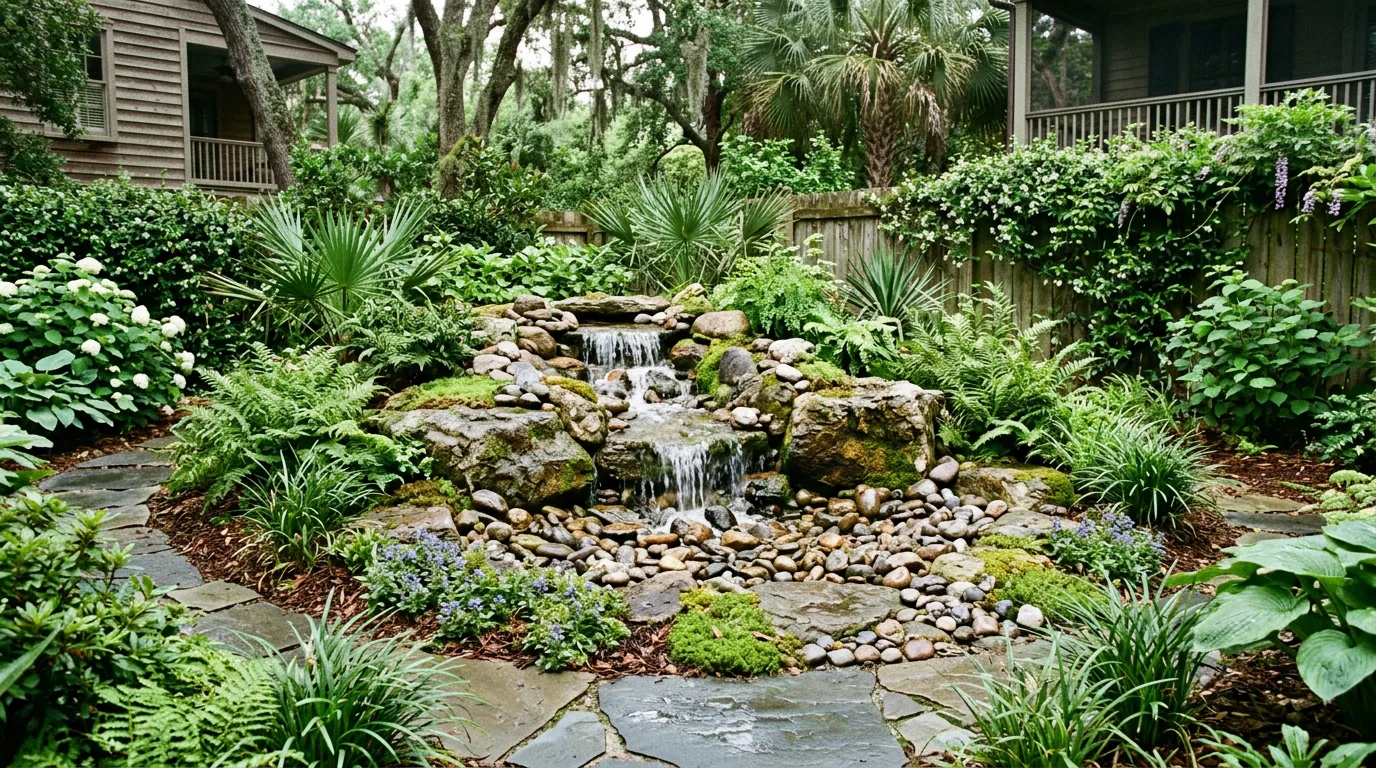
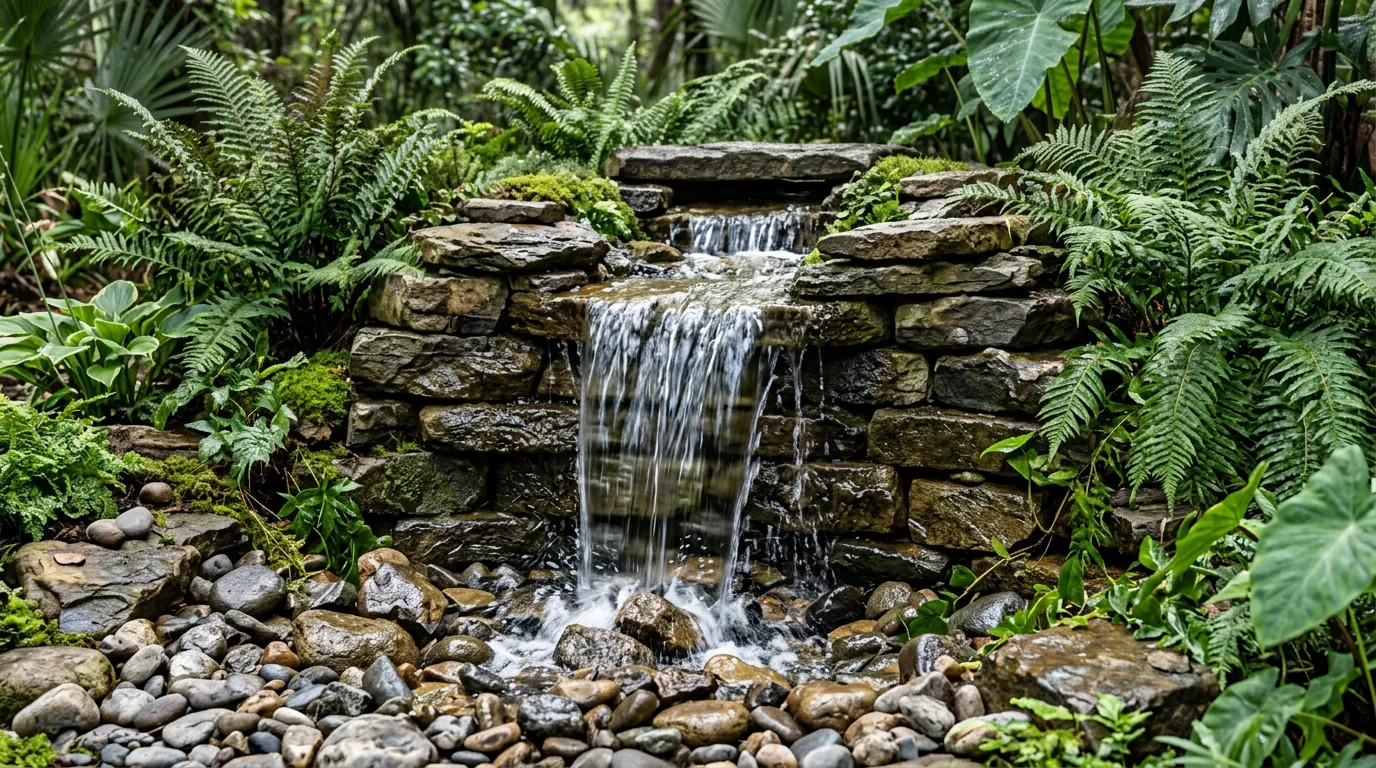
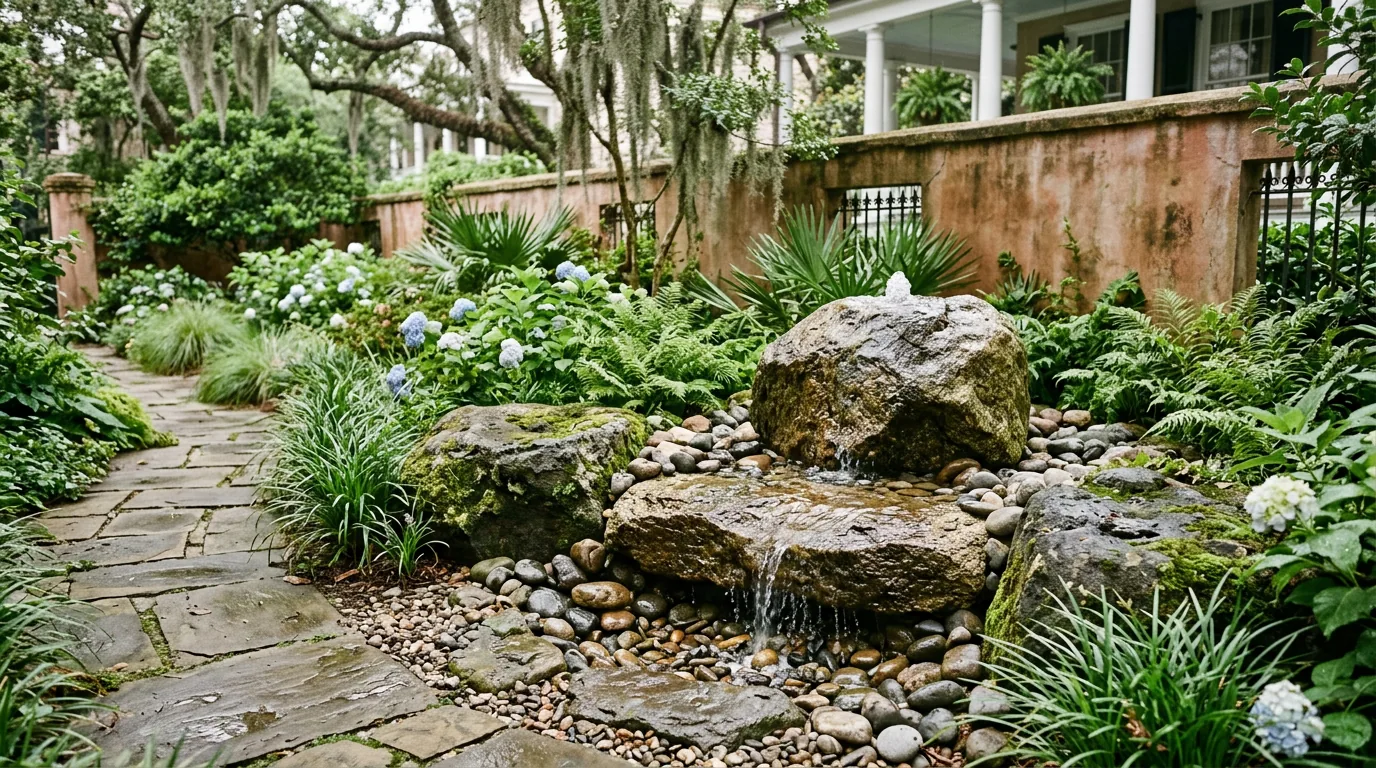
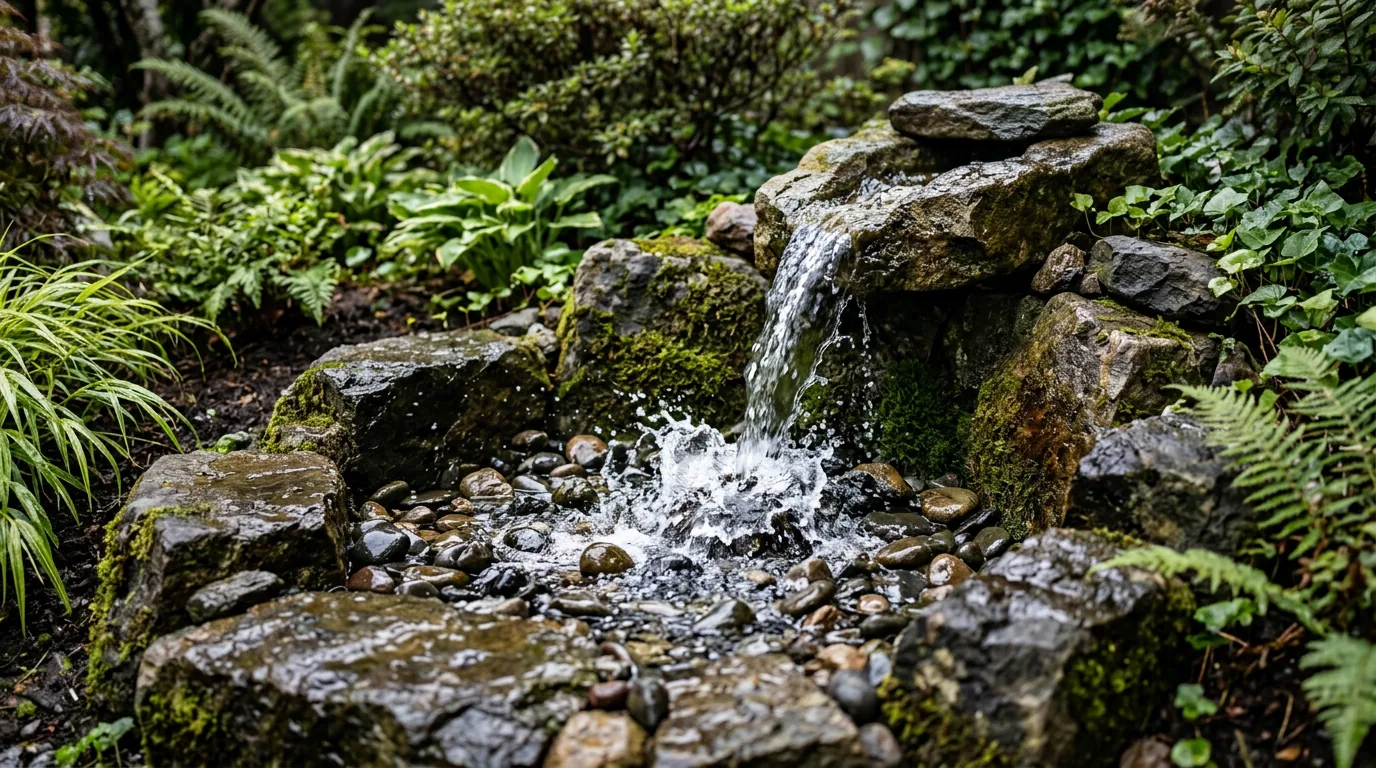
Water cascades over natural boulders into a hidden underground reservoir filled with gravel and river rock. The pump sits in the reservoir and recirculates water continuously to the top of the cascade. There is no open water surface of any kind — all water is below grade and in constant motion.
Bubbler column or urn
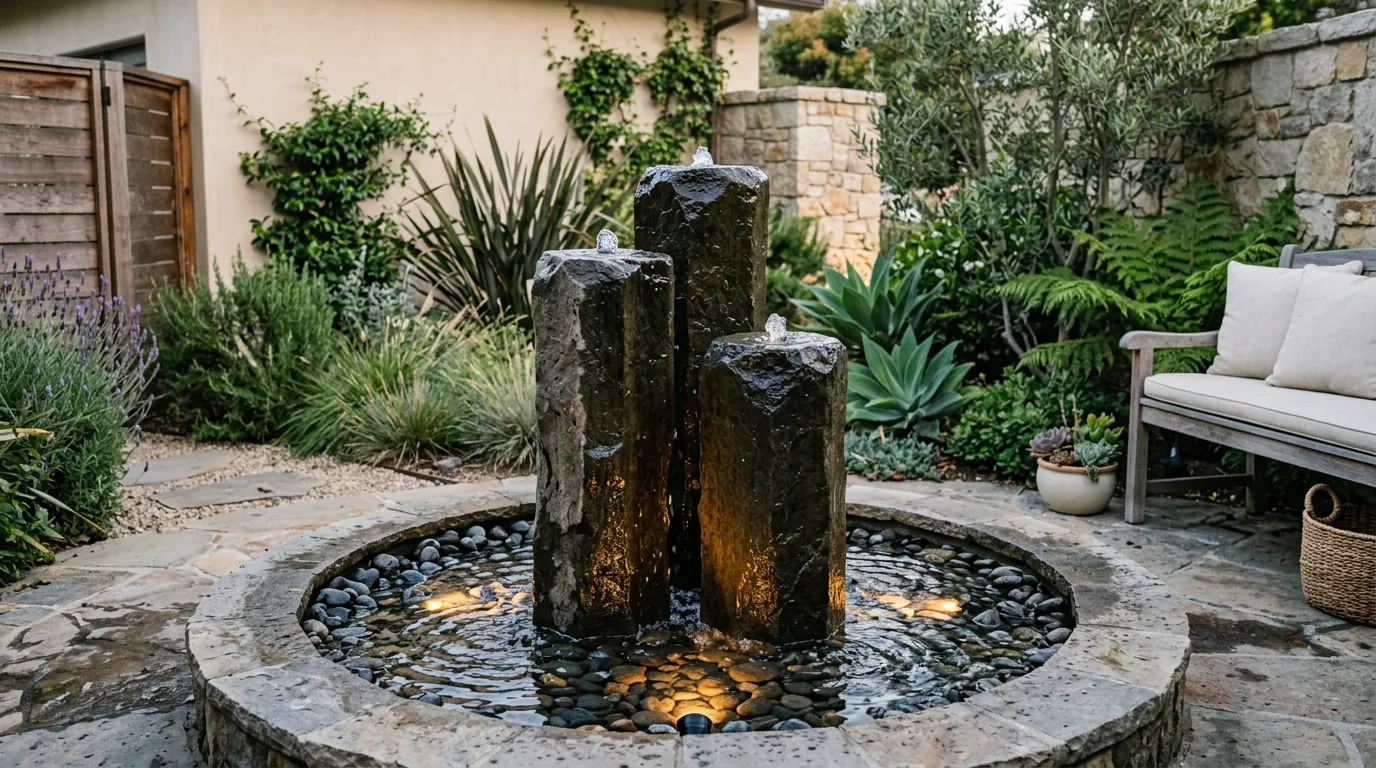
A single jet of water rises from a decorative column, urn, or millstone into a small catch basin and recirculates continuously. The water surface in the basin is constantly disturbed by the falling jet — no viable mosquito breeding surface. Excellent for entry gardens, courtyard spaces, and smaller properties where a full waterfall feature isn't to scale.
Recirculating stream
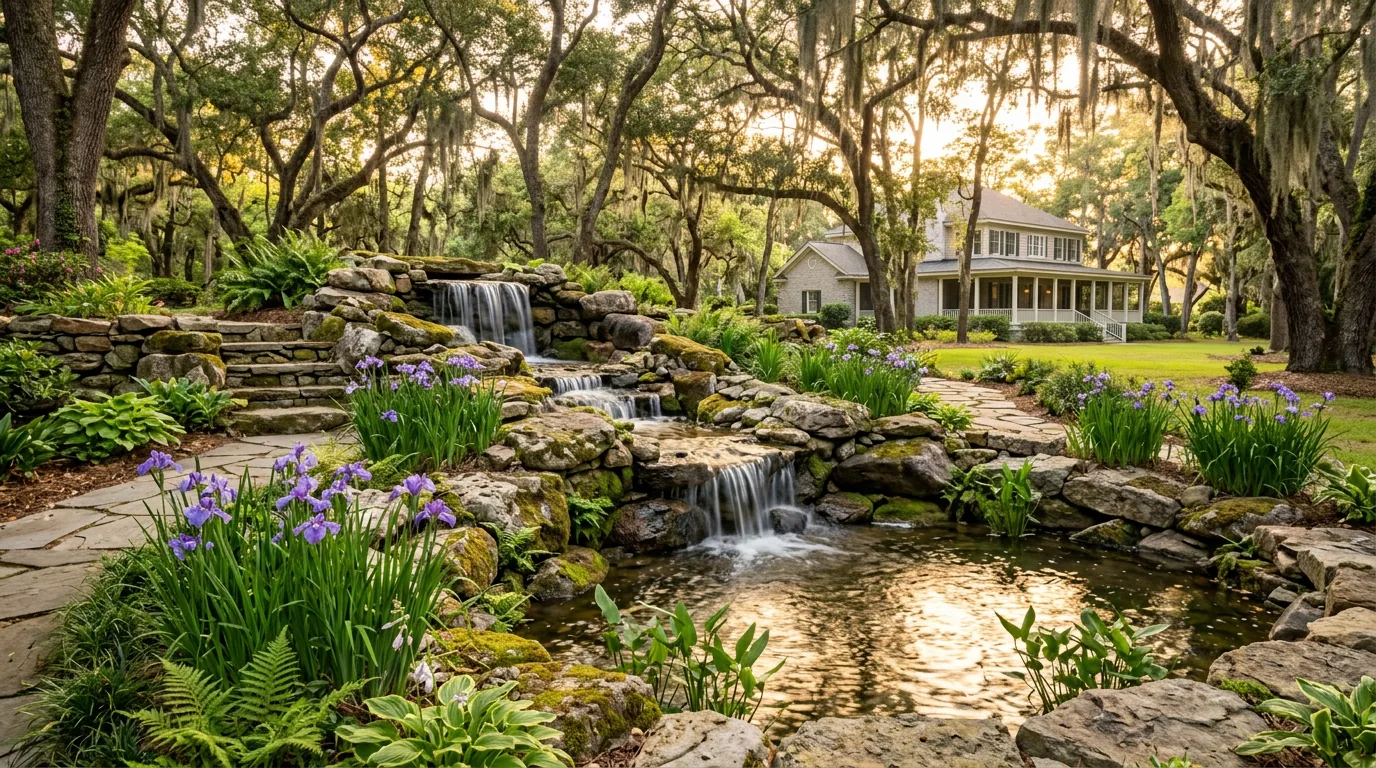
A naturalistic stream channel with a waterfall feature at one end, planted edges, and a small open basin at the other end. The basin creates some open water exposure — manageable with consistent monthly Bti dunk application and fish stocking. Beautiful and naturalistic, but requires more active management commitment than a pondless feature.
Open pond
A conventional backyard pond with significant open water surface area. DCM Outdoor will design and build open ponds when the client has a specific aesthetic reason for it, but recommends against them for most Lowcountry residential properties without a firm plan for active mosquito management. An open pond without active management becomes a mosquito nursery within one generation.
Why DCM Outdoor defaults to pondless for most Lowcountry properties
The pondless waterfall eliminates the mosquito management burden at the design stage rather than managing it operationally. There is no open water surface, so there is no breeding habitat — period. For homeowners who want the sound and visual movement of water without ongoing biological mosquito management, pondless is the right answer almost every time. DCM Outdoor recommends open pond or stream designs only when a client has a specific, clear reason for needing accessible water — and only after an honest conversation about what active management in this climate actually requires.
Mosquito risk comparison — Lowcountry conditions.
| Feature type | Lowcountry mosquito risk | Management required | DCM Outdoor recommendation |
|---|---|---|---|
| Pondless waterfall | Lowest | Debris clearing, annual pump clean | Recommended default |
| Bubbler column / urn | Very low | Debris clearing only | Excellent for small spaces |
| Spillway bowl / basin | Low | Keep pump running continuously | Good modern option |
| Recirculating stream | Moderate | Monthly Bti, fish stocking recommended | Manageable with commitment |
| Open pond | High without mgmt | Bti monthly, fish, pump, algae, cleaning | Not recommended for most LC properties |
The design elements that make a Lowcountry water feature perform well and last.
Right-sized pump
Pump GPH is calculated for the specific head height and pipe run of each installation. An undersized pump produces a disappointing trickle. An oversized pump overwhelms the cascade and creates spray outside the feature zone. DCM Outdoor calculates the correct specification before ordering — not after installation when the problem is obvious.
Natural boulder composition
Largest boulders placed first to establish the primary cascade structure. Each tier tested for water flow direction before the next tier is placed. Natural, irregular placement — no symmetrical stacking that reads as manufactured. Boulders set on firm bearing, not placed on soft ground that will settle and shift the water direction over time.
EPDM liner with underlayment
High-quality EPDM rubber liner over protective underlayment fabric. Liner extends minimum 12 inches beyond all excavated edges. All corners are folded and tucked — never cut. No sharp objects contact the liner at any point. The liner is the waterproofing layer that the entire feature depends on — DCM Outdoor does not cut corners here.
Lowcountry-native surrounding planting
Plants specified for the moisture and light conditions at the feature location — native Louisiana iris, river fern, sweetgrass, and dwarf palmetto for wet-edge applications. No plants placed where root growth could damage the liner over time. Planting design coordinates with any existing live oak root zones on the site.
Continuous operation setup
Pump wired to run continuously — 24 hours a day, 365 days a year. No timer that shuts the system off at night and creates still water conditions. The mosquito-safe design depends on continuous motion — a timer defeats the entire principle. DCM Outdoor sets up every water feature for continuous operation before project closeout.
GFCI-protected power
Every DCM Outdoor water feature pump connects to a GFCI-protected outdoor outlet — not an extension cord to an indoor circuit. If a GFCI outlet doesn't exist within 6 feet of the pump basin, DCM Outdoor coordinates with an electrician for a new outdoor circuit before scheduling installation. This is a safety requirement, not a preference.
Water features on Sullivan's Island, Kiawah, and Isle of Palms require marine-grade components.
Salt air at ocean-proximity concentrations accelerates corrosion of pump housings, fittings, and any metal components significantly faster than inland sites. A pump specified for a West Ashley installation will fail years earlier if installed on a Kiawah oceanfront property without coastal-grade specification.
Marine-grade specification for coastal water features
DCM Outdoor specifies the following on all water features within 500 feet of salt water: 316 stainless steel fittings and hardware (not standard 304 stainless or zinc-plated), corrosion-resistant pump housing rated for coastal environments, UV-stabilized flexible pipe throughout (not standard PVC, which becomes brittle faster in coastal UV exposure), and sealed junction box enclosures. The cost premium for marine-grade specification is modest relative to pump replacement labor and downtime. DCM Outdoor recommends it on every coastal site without exception.
Water features near live oaks require a specific approach — and DCM Outdoor knows it.
One of the most common site conditions DCM Outdoor encounters when designing water features is a desired location near or under a mature live oak canopy. The live oak's root system — which extends 2–3 times the canopy radius — creates a significant engineering challenge. Excavation within the drip line severs feeder roots. Basin installation over the root zone can suffocate roots through compaction and reduced oxygen exchange.
DCM Outdoor maps the Critical Root Zone of every significant live oak on a project site before any water feature design is finalized. For features that need to be placed near oaks, DCM Outdoor uses hand excavation within the drip line, avoids basin locations directly over the primary root zone, and designs the water routing to keep the footprint as small as possible within the root-sensitive area. This isn't a bureaucratic step — it's the difference between a water feature that enhances a magnificent oak and one that slowly kills it.
Water features that work beautifully near live oaks
A pondless waterfall positioned at the drip line edge — where the boulder cascade begins outside the root zone and the reservoir basin is located in a less root-sensitive zone — is DCM Outdoor's most common water feature design near mature live oaks. The feature appears to emerge from the live oak canopy, the uplighting from the water feature spills onto the lower trunk and root structure, and the sound of moving water fills the shaded space underneath. It's one of the most distinctly Lowcountry combinations in outdoor design.
Living with a Lowcountry water feature year-round.
DCM Outdoor provides every client with a complete maintenance guide at project completion. Here's what Lowcountry water feature ownership actually looks like across the seasons — including the live oak leaf drop challenge that surprises many first-time water feature owners.
Peak season startup
- Annual pump inspection — remove, rinse, check impeller for debris
- Check all plumbing connections for any winter movement
- Clean lens covers on any submersible lighting fixtures
- Top up reservoir after dry winter — water level drops with evaporation
- Restart any fish or aquatic plants if removed for winter
Active season management
- Monthly Bti dunk application on any open basin or stream
- Weekly top-up in dry periods — evaporation increases in SC summer heat
- Algae check — shade from surrounding planting reduces algae growth significantly
- Confirm pump is running continuously — never put it on a nighttime timer
- Check for debris accumulation in basin after storm events
Live oak drop season
- Lowcountry live oaks drop leaves, acorns, and catkins Oct–January — heaviest maintenance period
- Weekly debris clearing from basin surface and surrounding rock during drop
- Check basin water level — leaf matter decomposition can lower pH
- Clear any debris from pump intake after heavy drop events
- No winterization needed in Charleston — keep running year-round
The live oak leaf drop — the maintenance reality most contractors don't mention
Lowcountry live oaks drop their leaves, acorns, and catkins between October and January — the opposite of what most homeowners expect from an "evergreen" tree. If your water feature is under or near a live oak, this drop will deposit significant organic debris into the basin area over about a three-month period. DCM Outdoor designs accessible basin areas specifically to make this debris removal easy — a 20-minute weekly task rather than a major cleaning event. This is a normal and manageable part of Lowcountry water feature ownership, but it's worth knowing before installation rather than discovering it in November.
What water features cost in Charleston.
Water feature cost is driven by the scale of the cascade (boulder size and number of tiers), the basin size, surrounding planting scope, and whether lighting is integrated. DCM Outdoor provides fixed-price proposals after reviewing the specific site — not estimates that expand after excavation begins.
What drives water feature cost — and what's worth the investment
Boulder scale is the primary cost driver — specimen boulders of 500+ lbs each require equipment to place and cost proportionally more than smaller rocks. Multi-tier cascades cost more than single-tier because each tier requires its own structural base and water routing. Integrated submersible lighting adds $2,000–$6,000 depending on fixture count and is worth it for properties that will be used in the evenings — the visual effect of illuminated moving water at night is one of the strongest outdoor living features DCM Outdoor installs. The coastal site premium pays for itself within the first pump service cycle on any oceanfront or inlet-edge property.
Water features in the Lowcountry — answered directly.
A DCM Outdoor water feature — designed with continuous recirculation and no accessible still water surface — will not meaningfully increase your mosquito problem. Mosquitoes require still, shallow water to lay eggs and a calm water surface for larvae to breathe at for 7–14 days. Moving water disrupts both stages. The containers of still water already in your yard — gutters, pot saucers, wheelbarrows, birdbaths — are far more significant mosquito sources than a properly designed recirculating water feature. The question isn't "does water attract mosquitoes" — it does. The question is whether your water feature eliminates the conditions that allow mosquito breeding. DCM Outdoor designs every feature to eliminate those conditions.
A conventional backyard pond with open water surface in the Lowcountry requires consistent, active management to remain mosquito-safe — continuous water movement across the full basin, monthly Bti biological control applications, fish stocking for larval predation, and regular debris removal. A pondless waterfall eliminates this management burden entirely at the design stage: there is no accessible water surface, so there is no breeding habitat to manage. For homeowners who want the visual movement and sound of water without the ongoing biological management of an open water body, pondless is the right answer in this climate almost every time. DCM Outdoor recommends open-water designs when a client has a specific, considered reason for them — and only after a frank conversation about what active management in a Charleston summer actually requires.
Bti stands for Bacillus thuringiensis israelensis — a naturally occurring soil bacterium that is toxic to mosquito and black fly larvae but harmless to fish, birds, mammals, bees, and humans. It comes in dunk or granule form (the most common brand is Mosquito Dunks) and is dropped into any open water basin monthly. The bacteria disperse through the water and are ingested by mosquito larvae during their feeding stage, preventing the larvae from completing development. Bti is DCM Outdoor's recommended biological control for any water feature with an open basin component — it's inexpensive (about $10/month), safe, and highly effective when applied consistently. DCM Outdoor provides a Bti application schedule and supplier recommendation at every project completion where open water is present.
Modern energy-efficient magnetic-drive pumps use significantly less electricity than older models. A typical pondless waterfall pump — 2,000–4,000 GPH for a medium-scale residential feature — draws approximately 50–120 watts running continuously. At South Carolina's average residential electricity rate, that's roughly $4–$9 per month for continuous operation. For context, that's less than a bathroom exhaust fan running 24 hours a day. Higher-flow pumps for larger installations draw proportionally more, but the efficiency of modern mag-drive technology makes continuous operation quite affordable. DCM Outdoor specifies the correct pump size for each installation — an oversized pump wastes electricity and overwhelms the cascade; an undersized pump saves nothing in the long run because it can't do the job.
Not in a standard pondless installation — the gravel-filled reservoir is not a suitable fish habitat because fish need open water to swim and adequate dissolved oxygen at sufficient depth. Fish can be added to stream features or open basin designs where there is accessible open water of appropriate depth (minimum 18–24 inches for feeder goldfish, deeper for koi). If you want both the pondless aesthetic and fish, DCM Outdoor can design a hybrid system with a larger hidden basin section that provides accessible water habitat while maintaining the pondless appearance from above. This adds cost but is a legitimate design option for clients who specifically want fish as part of the feature.
Pondless waterfall features handle hurricane conditions reasonably well — the underground basin provides reservoir volume to absorb heavy rainfall, and the boulder cascade is stable under wind load. DCM Outdoor recommends turning the pump off and removing any submersible lighting fixtures before a named storm event as a precaution. After the storm, check for debris in the basin, inspect the liner for any damage from wind-blown debris, and verify the pump inlet is clear before restarting. For coastal properties, move any portable decorative elements (urns, bowls) inside before the storm. DCM Outdoor provides a full storm preparation checklist at project completion.
Yes — DCM Outdoor regularly integrates submersible LED lighting into pondless waterfalls and spillway features. Submersible fixtures inside the cascade illuminate the falling water from below, creating a glowing, animated effect after dark that looks entirely different from the daytime feature. Uplighting of the surrounding boulder composition and planting from above completes the effect. All submersible fixtures are IP68-rated (fully submersible indefinitely) and specified for outdoor water environment use. Lighting adds $2,000–$6,000 to a typical water feature installation depending on fixture count and access complexity. DCM Outdoor's nighttime walkthrough standard applies to water feature lighting installations just as it does to landscape lighting — the project isn't closed until you've seen the result after dark.
Water features in the Lowcountry — client experiences.
"We had a massive mosquito concern before going ahead with a water feature. DCM Outdoor explained the pondless design in detail, why there would be no accessible standing water, and what to expect. Two seasons later — no mosquito increase, and the waterfall is the feature that guests always comment on first."
"DCM Outdoor told us about the live oak leaf drop and what to expect for maintenance before we installed. We were glad they did — October to January is real work, but it's a 20-minute weekly task not the nightmare we'd feared. And having moving water under our oak at night is unlike anything we'd seen before."
"The integrated lighting in the waterfall is the most surprising feature on our property. In the daytime it's a beautiful naturalistic cascade. At night with the submersible LEDs on it becomes something completely different — the water glows and moves and it's all anyone wants to look at. DCM Outdoor's nighttime walkthrough sealed the deal."
"I specifically asked DCM Outdoor to tell me if a water feature was a bad idea on our Kiawah property. Their honest answer was that it's fine with marine-grade hardware and the right design. Two years on the coast and the pump and fittings look exactly as they did on day one. Worth the specification premium."
Charleston outdoor living services